Do you care if it leaks?
Geosynthetics are engineered polymer materials used to enhance the performance of soil, rock, and water systems. The International Geosynthetics Society (IGS) defines them as materials that perform one or more of six key functions: separation, filtration, drainage, reinforcement, protection, and containment (IGS, n.d.).
Within this family, geomembranes are the containment specialists – thin polymer sheets that act as barriers against liquids and gases. Their purpose is simple but vital: prevent the uncontrolled movement of water, leachate, chemicals, or vapors into the environment.
The most significant use of geomembranes began following the USA Resource, Conservation and Recovery Acts (RCRA) in the late 1970’s. There was a need to contain waste and protect goundwater/drinking water. Regulators and Engineers recognized that polymeric materials could deliver lighter, safer, and more sustainable infrastructure than traditional mineral barriers. Today, geomembranes are essential in landfill lining systems, mining operations, water conservation projects, and energy infrastructure.
A geomembrane is a continuous sheet of polymeric material designed to have extremely low permeability.
The most common types are based on polyethylene (HDPE and LLDPE), polyvinyl chloride (PVC), flexible polypropylene (fPP), and synthetic rubber compounds such as EPDM (Müller & Saathoff, 2015; USBR, 2018).
Each polymer type is selected for its balance of mechanical strength, flexibility, and resistance to environmental stress.
Material | Key traits | Common uses |
|---|---|---|
HDPE | High chemical resistance, low permeability, excellent strength | Hazardous waste, Landfill base liner, mining pads, reservoirs |
LLDPE | Flexible and adaptable, good elongation | Caps and Closures, Ponds, canals, irregular subgrades |
PVC | Soft, easy to weld, economical | Temporary works, decorative ponds |
fPP / EPDM | Highly flexible, UV-resistant | Golf course ponds, fresh water containment |
To achieve longevity, base resins are blended with antioxidants, UV stabilizers, carbon black, and heat stabilizers (IJAA R, 2018). These additives slow the degradation caused by sunlight, oxidation, and mechanical stress.
Manufacturing typically involves blown-film or flat-die extrusion, producing uniform rolls up to several meters wide. Each roll undergoes rigorous quality control – testing for many properties including tensile properties puncture resistance, and thickness before shipment (USBR, 2018).
Geomembranes are used wherever a controlled hydraulic or gas barrier is required. Their applications span environmental, civil, industrial, and energy sectors.
Landfills and waste containment: Geosynthetics (geomembranes, drainage geocomposites, and geosynthetic clay liners) form a composite system that prevent leachate migration and capture landfill gas for recovery (Assessment and Recommendations for Improving the Performance of Waste Containment Systems ).
Hazardous waste facilities: Geomembranes used in combination with geosynthetic clay liners (GCLs) and leak detection systems in a double composite system to meet stricter regulatory standards.
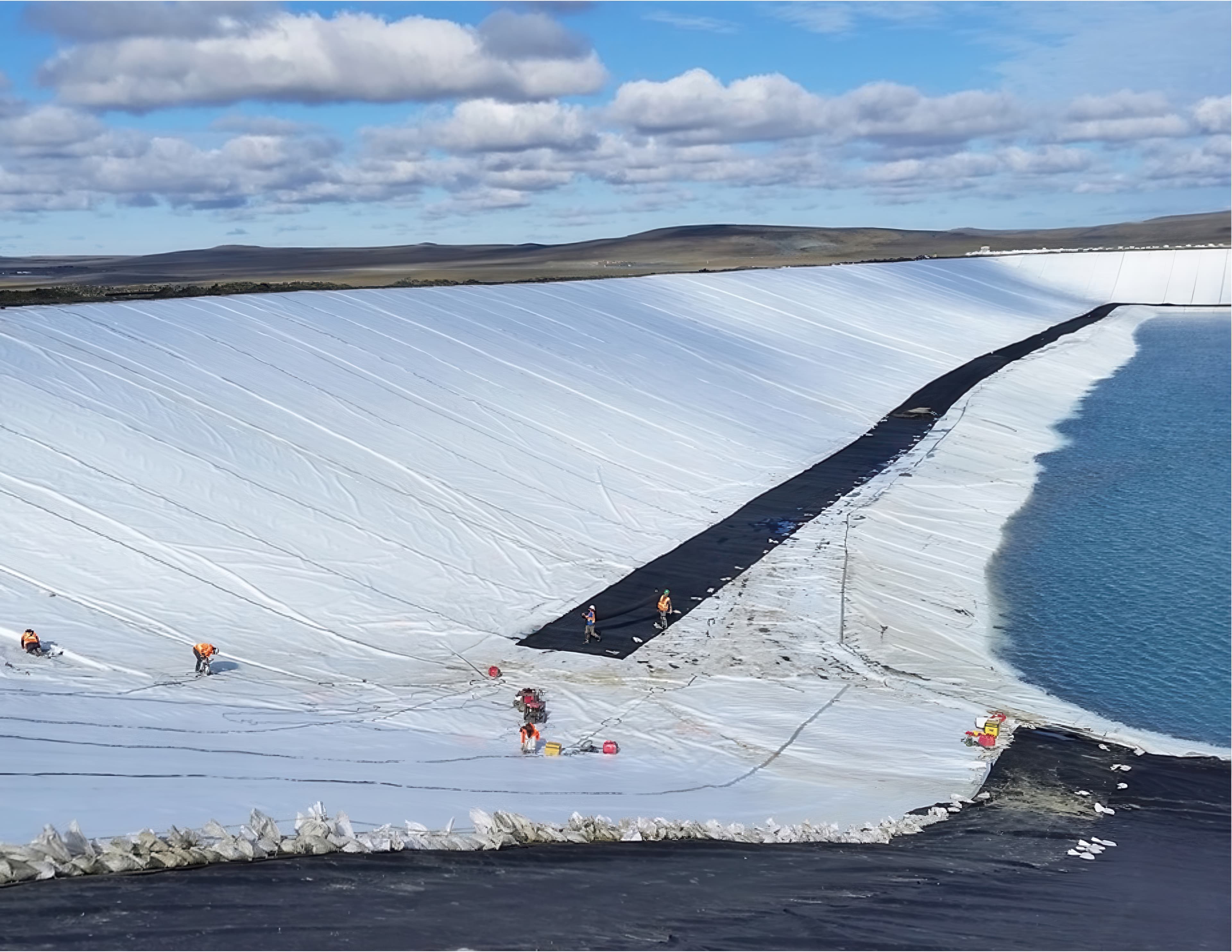
Canals, reservoirs, and irrigation ponds: Reduce seepage losses in arid regions and protect earthen embankments from erosion (USBR, 2018).
Stormwater and wastewater basins: Provide secure containment for municipal or industrial effluent.
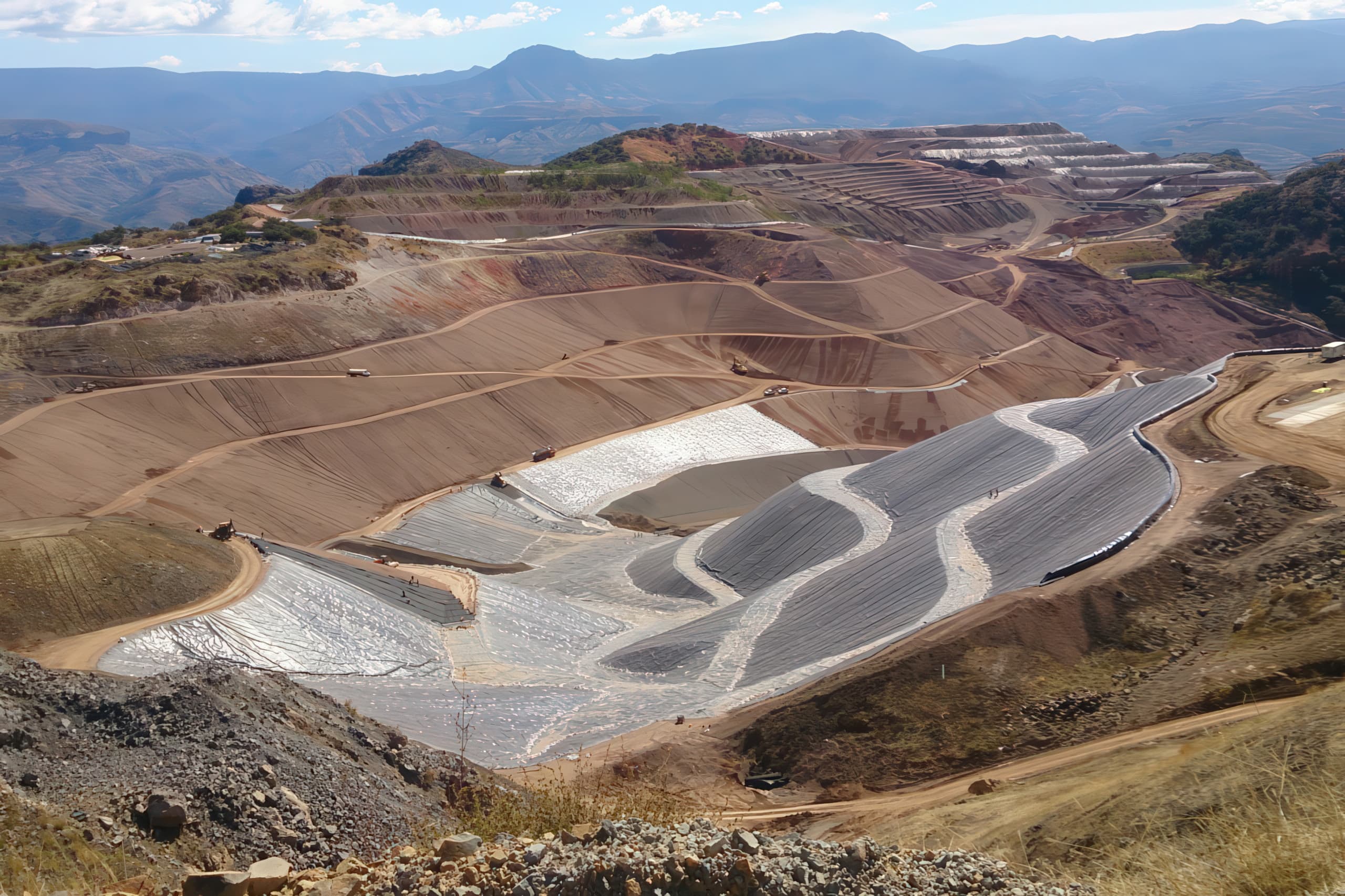
Heap leach pads: Prevent cyanide or acid leach solutions from entering groundwater (Breitenbach & Smith, 2016).
Tailings dams and process ponds: Isolate fine waste and reduce water contamination risks.
Energy projects: Used in solar farms, biogas plants, and oil containment basins for impermeability and safety.
Because geomembranes can be installed over almost any soil type, they enable construction in challenging conditions where compacted clay barriers would be impractical or uneconomical.
Material selection depends on project scale, environmental exposure, chemical compatibility, and service life requirements.
HDPE is the most universally used for critical containment as it combines low permeability with chemical and UV resistance.
LLDPE offers greater flexibility and is less effected by uneven and unstable subgrades, while maintaining excellent chemical resistance. PVC remains popular for small reservoirs or temporary works, though it is more sensitive to sunlight and will lose plasticizers over time. fPP and EPDM excel in freshwater applications due to their elasticity and fatigue and weathering resistance and installation without specialized equipment.
The U.S. Bureau of Reclamation (2018) recommends that engineers consider mechanical demands (tensile, puncture, tear), environmental exposure, and ease of installation before specifying a particular polymer. Each type has trade-offs, but the principle remains the same: the right geomembrane is the one that balances performance with constructability.
The comparison between PVC and HDPE is often framed around flexibility versus durability.
PVC is softer, lighter, and easier to handle on-site. It can be cut and folded without specialized machinery, making it well suited to smaller or irregular installations. HDPE, by contrast, is stiffer and more difficult to manipulate, but it offers unmatched chemical resistance, low permeability, and much better long-term performance (Müller & Saathoff, 2015).
Another major distinction lies in seaming methods: PVC liners are joined using the addition of a solvent or chemical bonding, whereas HDPE liners are fusion welded using hot wedge and extrusion techniques. This introduces no additional components to the barrier system Fusion welds create a homogeneous joint that is often stronger than the liner itself (USBR, 2018).
From a life-cycle perspective, HDPE liners typically achieve service lives well exceeding 50 years when buried, compared to 15–25 years for exposed PVC (USBR, 2018). PVC remains a practical choice for temporary or low-cost applications, while HDPE is the benchmark for critical, long-term containment.
The performance of a geomembrane system depends as much on installation quality as on the material itself.
According to the U.S. Bureau of Reclamation (2018) and FHWA (1998), proper installation involves:
Subgrade preparation: Grading, compaction, and removal of sharp particles.
Panel layout: Overlaps oriented down-slope to minimize stress and leakage potential.
Welding or bonding: Fusion welders (for polyethylenes) or chemical welders (for PVC) create continuous joints.
Testing: Every seam undergoes non-destructive testing – typically air-pressure, vacuum box, or ultrasonic – and periodic destructive testing for peel and shear strength.
Anchoring and protection: Perimeter trenches, ballast, or cover soil secure the liner and prevent uplift.
Field crews work to strict construction quality assurance (CQA) plans that track every seam and test result. Even the most robust material can fail prematurely if welding or anchoring is neglected; conversely, a well-installed liner can perform flawlessly for decades.
Watertightness results from a combination of material properties, system design, and construction discipline.
According to Rowe (2012), effective containment relies on:
Low-permeability polymers: HDPE and LLDPE achieve hydraulic conductivities as low as 10⁻¹⁴ m/s.
Continuous, defect-free seams: Verified fusion welds prevent preferential flow paths.
Composite liner systems: Pairing geomembranes with geosynthetic clay liners (GCLs) or compacted clay layers provides greatly improved barrier performance.
Subgrade smoothness and support: Minimizes puncture and strain concentrations.
Protective layers: Non-woven geotextiles or sand cushions prevent mechanical damage.
Rowe’s field data show that even with small defects, leakage from a well-constructed composite system remains negligible – often less than a few liters per hectare per day.
In practice, watertightness is not only about impermeable materials; it’s about integration, testing, and quality control throughout construction.
Geomembrane longevity varies by polymer type and environmental exposure. The U.S. Bureau of Reclamation (2018) and Rowe (2012) identify four dominant aging mechanisms:
Thermal oxidation (heat + oxygen).
UV degradation (for exposed liners).
Chemical attack from aggressive fluids.
Mechanical stress from differential settlement or load.
Buried HDPE liners can exceed 100 years of effective performance if protected from sunlight and high temperatures. (Koerner) Exposed HDPE liners generally last 20–30 years depending on climate, while PVC liners degrade faster due to plasticizer migration and UV sensitivity (Müller & Saathoff, 2015).
Longevity is extended through:
Protective cover soil or ballast.
Periodic inspection for cracks or wrinkles.
Proper material specification based on chemical compatibility.
Quality assurance during installation to prevent early stress damage.
Service life prediction models developed by Rowe and colleagues demonstrate that oxidation can take decades to initiate under normal temperatures – meaning modern geomembranes can easily meet, and often exceed, design lives of half a century.
Experience across landfill, mining, and water projects has highlighted recurring mistakes that compromise liner performance (FHWA, 1998; Rowe, 2012):
Inadequate subgrade preparation leading to punctures.
Uncontrolled wrinkles in welded seams, which increase leakage potential.
Poor seam cleanliness – dust, condensation, or oil contamination weaken welds.
Improper anchoring causing uplift or tension during filling or drawdown.
Overlooking thermal movement – expansion and contraction in HDPE can exceed 2 % of panel length.
Mitigation lies in meticulous CQA documentation and trained installation crews. Every weld, patch, and test becomes part of a traceable quality record – the foundation for long-term containment assurance.
Geomembranes have transformed the way engineers manage water and waste. They are thin barriers with enormous environmental impact – preventing groundwater contamination, conserving scarce water resources, and enabling industrial processes to operate responsibly.
Their performance depends not only on polymer science but also on design integration and workmanship. When properly designed, installed, and maintained, a geomembrane system can safeguard ecosystems for generations – proving that environmental protection and engineering efficiency can coexist in a single sheet of material.
References
Breitenbach, A. J., & Smith, M. E. (2016). Overview of Geomembrane History in the Mining Industry. 911 Metallurgist.
Federal Highway Administration (FHWA). (1998). Geosynthetic Design & Construction Guidelines (HI-95-038). U.S. Department of Transportation.
Geosynthetics Magazine. (2023, Sept 7). Geomembranes for Beginners. Industrial Fabrics Association International.
International Geosynthetics Society (IGS). (n.d.). What Are Geosynthetics?
International Journal of Applied Research (IJAA R). (2018). Geotextiles & Geomembranes: Properties, Production and Engineering Applications.
Müller, W. W., & Saathoff, F. (2015). Geosynthetics in Geoenvironmental Engineering. Environmental Geotechnics.
Rowe, R. K. (2012). Short- and Long-Term Leakage through Composite Liners. Canadian Geotechnical Journal.
U.S. Bureau of Reclamation (USBR). (2018). Design Standards No. 13 – Chapter 20: Geomembranes. Technical Service Center, Denver.
US EPA (1991) Assessment and Recommendations for Improving the Performance of Waste Containment Systems. National Service Center for Environmental Publications (NSCEP), USA.
Koerner, R. Lifetime Predictions of Exposed Geotextiles and Geomembranes Proceedings of GeoAmericas 2016 3rd Pan-American conference on Geosynthetics, Miami, FL USA

